
Best Solar Cleaning Brushes in Ghaziabad for Reliable Solar Performance
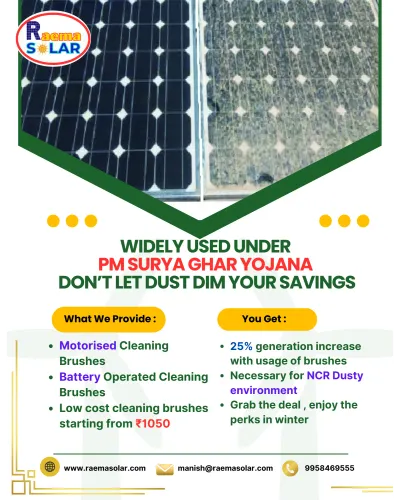
Dirty solar panels in Ghaziabad reduce power and savings every day 📉
For residential and institutional rooftop solar systems in Ghaziabad, performance loss often goes unnoticed at first. Panels look fine from the ground, the inverter is running, but daily power generation slowly drops.
The reason is not a fault in the system. It is surface contamination.
In Ghaziabad’s environment, the sequence is clear:
dust and pollution settle daily → sunlight absorption reduces → daily units fall → monthly financial returns decline.
Unless panels are cleaned correctly and on time, this loss continues silently.
Why this problem is severe in Ghaziabad
Ghaziabad faces some of the toughest operating conditions for rooftop solar systems in the NCR region.
Key environmental factors include:
- Heavy dust from construction and high traffic movement
- NCR-level air pollution and smog forming a thin layer on panel glass
- Construction residue in residential and commercial zones
- Light rainfall that spreads dirt instead of washing it off
For residential rooftop solar systems in Indirapuram or builder floors in Raj Nagar Extension, dust settles within days. For schools, hospitals, and society rooftops in areas like Vaishali or Vasundhara, access challenges often delay proper cleaning.
Unlike regions with heavy monsoon cleaning cycles, Ghaziabad panels accumulate layered residue that blocks sunlight consistently.
Cause and effect: how dirty panels reduce solar output
From a technical standpoint, solar panels depend on clean glass surfaces to allow maximum sunlight transmission.
When pollution film and dust accumulate:
- Light transmission reduces
- Panel surface temperature increases
- Inverter output becomes inconsistent
- Daily power generation drops
In practical terms, a rooftop system expected to generate 100 units per day may start producing only 80–85 units. Over a month, this results in a clear financial loss for homeowners and institutions.
For large society rooftops, the impact multiplies across multiple buildings.
Ghaziabad-based case example
In a housing society in Indirapuram, two similar rooftop solar installations operated under identical sunlight conditions.
- One system followed irregular manual cleaning
- The other adopted scheduled maintenance using proper solar cleaning brushes
The regularly cleaned installation delivered 15–20% higher daily output over a sustained period. Inverter data showed more stable daily units and fewer performance dips ⚡.
A similar pattern was observed on a school rooftop in Vaishali, where regular brush-based cleaning replaced occasional water washing. Power generation became more consistent within weeks.
These outcomes were observed during normal operations, without changes to equipment or layout.
Why manual or water-based cleaning does not work
Many solar owners rely on cleaning methods that seem simple but cause long-term issues:
- Water pipes or pressure washing
- Cloth wiping by untrained staff
- Infrequent, unscheduled cleaning
These practices lead to:
- Micro-scratches on panel glass
- Uneven cleaning across panel rows
- Residue left behind after drying
- Safety risks on rooftops
Once micro-scratches form, dust sticks faster, making future cleaning less effective and accelerating efficiency loss.
Why solar cleaning brushes are the most reliable solution
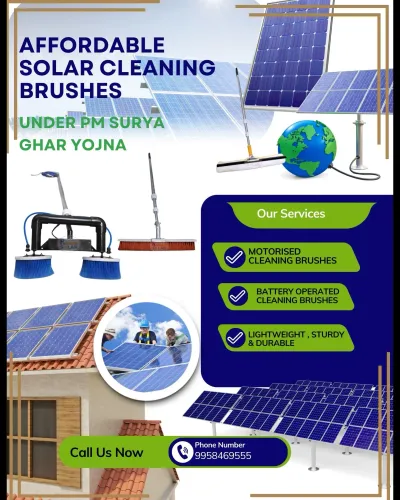
Solar cleaning brushes are designed specifically for rooftop solar systems operating in polluted urban environments like Ghaziabad.
A proper solar cleaning brush:
- Removes fine dust and pollution film safely
- Prevents glass surface damage
- Enables dry or low-water cleaning
- Ensures uniform cleaning across large rooftops
- Maintains consistent daily power generation
For residential rooftops, manual or battery-operated brushes allow safe cleaning without risky access methods. For societies, schools, and hospitals, motorized brushes reduce manpower dependency and improve cleaning coverage.
As one of the largest solar cleaning brush manufacturers, our experience across Ghaziabad rooftops shows that correct cleaning equipment directly impacts system efficiency and ROI.
Residential and institutional relevance
For homeowners:
Regular brush-based cleaning restores expected daily units and protects monthly electricity savings.
For housing societies:
Standardized cleaning improves ROI predictability and reduces maintenance complaints.
For schools and hospitals:
Stable solar output supports operational budgets and ensures dependable power availability.
In every case, cleaning quality matters as much as cleaning frequency.
Frequently asked questions
How often should solar panels be cleaned in Ghaziabad?
Every 7–10 days during high dust and pollution periods, and at least twice a month otherwise.
Does rain clean solar panels effectively in Ghaziabad?
No. Light rain usually spreads dirt into a thin residue layer.
Can improper cleaning permanently damage panels?
Yes. Micro-scratches reduce long-term efficiency and accelerate dust buildup.
Are solar cleaning brushes suitable for large rooftops?
Yes. Motorized and battery-operated brushes are designed for society and institutional rooftops.
Is investing in cleaning equipment financially justified?
Yes. Recovered power generation often offsets the equipment cost within a short period.
Internal Linking Suggestions
- Rooftop solar maintenance best practices
- Solar ROI optimization for housing societies
- Safe solar panel cleaning methods
What to do next ☀️
If solar panels in Ghaziabad are not being cleaned properly, power generation is already compromised. The loss may not be obvious day to day, but it directly affects monthly savings and long-term system value.
Speak with our sales team today to choose the right solar cleaning brush based on rooftop size and usage. Get clear guidance on pricing, cleaning frequency, and bulk supply options.
In Ghaziabad’s pollution-heavy environment, proper solar cleaning is essential for protecting solar ROI.
Keywords