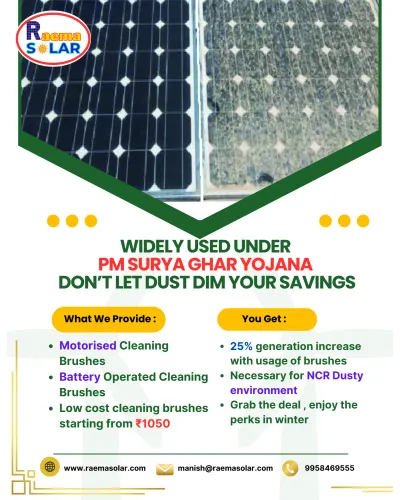

Introduction: The Quiet Drop in Solar Output Jaipur Owners Notice Too Late
In Jaipur, rooftop solar has become a practical choice for homes, hotels, and commercial buildings. The expectation is straightforward—strong sunlight should translate into consistent daily power and predictable savings.
Yet many solar owners notice a steady dip in generation after the first few months. Panels look intact. Inverters report normal operation. Still, the numbers slide. In Jaipur, this is rarely an electrical issue. It is environmental. Dirty solar modules reduce daily power output and quietly push ROI further away. 📉
Why This Issue Is Severe in Jaipur
Jaipur’s climate is semi-arid, with long dry spells and frequent dust movement. Hot winds carry fine desert dust across rooftops. Construction activity adds another layer of particulate matter, especially in expanding residential and commercial zones.
Key local conditions affecting solar modules include:
- Desert dust settling daily on exposed surfaces
- Hot summers that bake dust onto module glass
- Low rainfall that fails to wash panels clean
- Urban construction releasing fine particulate dust
For residential and commercial rooftop solar systems in Jaipur, these factors mean dust accumulation is continuous rather than occasional.
Problem → Cause → Solution → Result
Problem
Solar systems generate fewer units than projected, even under clear skies.
Cause
In Jaipur’s dry, semi-arid and dust-heavy environment, fine particles settle on solar modules every day. High temperatures cause this dust to bond with the glass surface. Occasional rain spreads dirt across the panel instead of removing it.
Solution
Regular, planned cleaning using solar module cleaning brushes designed for desert and dry climates.
Result
Restored light absorption, stable daily generation, and predictable long-term system performance.
This cause-and-effect cycle is consistent across homes, hotels, and commercial rooftops in Jaipur.
How Much Power and Financial Loss Occurs in Jaipur?
Based on observed performance patterns across Jaipur rooftops:
- Residential systems often lose 1–2 units per day when modules remain dusty
- Hotels and commercial buildings see higher absolute losses due to larger system sizes
- Over a year, this loss delays payback and reduces expected savings
Because the decline happens gradually, many owners only recognize the issue during annual performance reviews rather than daily monitoring.
Local Case Study: Hotel Rooftop Near Vaishali Nagar
A mid-sized hotel operating near Vaishali Nagar installed a rooftop solar system to offset daytime energy consumption. Cleaning was irregular and depended largely on occasional water washing.
Before structured cleaning:
- Dust visible on modules within days
- Fluctuating daily unit generation
- Gradual month-on-month drop in output
Change implemented:
The hotel adopted scheduled cleaning using solar module cleaning brushes suitable for dry, dust-heavy environments.
After regular brush-based cleaning:
- 15–20% improvement in power generation
- Consistent daily units even during peak summer ⚡
- Reduced manual effort and safer rooftop maintenance
No changes were made to panels or electrical equipment. Performance improved solely through better surface cleaning.
Why Manual or Water-Based Cleaning Fails in Jaipur
Many solar owners assume water and cloth cleaning is sufficient. In Jaipur’s climate, this approach often causes long-term issues.
Common problems include:
- Micro-scratches caused by dragging dust particles across glass
- Uneven cleaning that leaves residue streaks
- High water usage with limited cleaning effectiveness
- Safety risks on large hotel and commercial rooftops
Over time, scratched module glass attracts more dust, accelerating efficiency loss.
Why Solar Module Cleaning Brushes Deliver Consistent Results
Solar module cleaning brushes are engineered specifically to handle fine dust without damaging the glass surface.
Their effectiveness comes from controlled pressure and soft bristles that lift dust rather than grind it into the panel. For Jaipur’s desert-like conditions, this approach is both safer and more reliable.
Key advantages include:
- Protection of module glass integrity
- Uniform cleaning across large rooftop arrays
- Options for manual, motorized, and battery-operated use
- Faster cleaning cycles for hotels and commercial buildings
For industrial and commercial solar module cleaning in Jaipur, brush-based systems provide repeatable performance improvement.
How Often Should Solar Panels Be Cleaned in Jaipur?
Cleaning frequency depends on exposure:
- Residential rooftops: every 2–4 weeks
- Hotels and commercial buildings: more frequent during summer and dust storms
- Large rooftops: scheduled cleaning is essential
Regular cleaning prevents dust bonding, reduces thermal stress, and protects long-term output.
Engineering Logic and Long-Term ROI Protection
Solar installations in Jaipur are long-term financial assets. Their success depends on sustained performance over decades, not just initial output.
Consistent brush-based cleaning:
- Preserves daily and annual energy generation
- Prevents surface abrasion
- Stabilizes ROI calculations
- Extends the effective working life of the system
From an engineering and financial standpoint, cleaning is a performance safeguard rather than a routine expense.
Brand Positioning
As one of the largest solar cleaning brush manufacturers, the brand is trusted by homeowners, hotels, commercial buildings, and EPC partners. The products are designed specifically for Indian desert and dry environments where dust control directly determines solar performance.
Keywords