
Solar adoption across Coimbatore has grown steadily over the last decade. Independent homes, apartment rooftops, textile mills, and manufacturing units increasingly depend on solar systems to control power costs and stabilize long-term energy expenses.
Yet, across the city, many solar owners quietly experience the same issue. Their systems are functioning, but daily power generation is consistently lower than expected. In most cases, the root cause is simple and operational: solar modules are not being cleaned effectively 📉.
The Core Problem in Coimbatore
In Coimbatore’s industrial and dry-climate environment, solar modules accumulate contamination much faster than many owners realize. This is not limited to factories or large sheds. Even residential rooftops are affected.
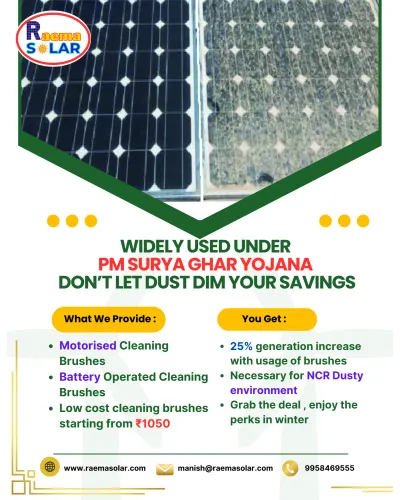
Fine dust from industrial activity, textile residue in the air, and dry weather conditions combine to form a persistent layer on the module surface. This layer reduces the amount of sunlight reaching the solar cells.
The system does not stop working. It simply produces fewer units every day.
Why This Issue Is More Severe in Coimbatore
Several local factors make solar module contamination a recurring issue:
- Dry climate with minimal natural cleaning
- Industrial and textile dust suspended in the air
- Heat that causes dust to bond tightly to glass surfaces
- Limited rainfall effectiveness, which does not wash panels clean
In areas such as Peelamedu, Ganapathy, and SIDCO Industrial Estate, airborne particles are part of the environment. Once these particles settle on hot module surfaces, they adhere firmly.
Cause → Effect:
When dust bonds to the glass, sunlight transmission reduces. Reduced sunlight directly results in lower daily power generation.
How Much Power and Financial Loss Occurs?
Across residential and industrial rooftop systems in Coimbatore, the impact of unclean solar modules is measurable:
- 10–20% reduction in daily power output is commonly observed
- Monthly savings fall short of projections
- Large industrial rooftops experience compounding financial loss due to scale
For a residential rooftop system, this often shows up as a steady drop in monthly units. For textile units and manufacturing sheds, the financial impact is significantly higher because generation loss affects operational cost planning ⚡.
The critical issue is that this loss often goes unnoticed because the system continues to run.
Local Case Example: Textile Unit Rooftop in Peelamedu
A mid-sized textile manufacturing unit in Peelamedu installed rooftop solar to offset daytime power consumption.
Before Structured Cleaning
- Panels cleaned occasionally with water
- Textile residue and dust returned quickly
- Daily generation showed a gradual decline
After Using Solar Module Cleaning Brushes
- Regular cleaning using dedicated cleaning brushes
- Minimal water usage
- Uniform cleaning across all module rows
Observed Result
- 15–20% improvement in power generation
- Stable and predictable daily units
- Improved consistency in monthly energy output
The improvement was achieved without changing panels or inverters. It came purely from effective maintenance.
Why Manual or Water-Based Cleaning Fails in Coimbatore
Many solar owners rely on basic cleaning methods, assuming they are sufficient. In Coimbatore’s environment, these methods often fail over time.
Common issues include:
- Water spreading fine dust into a thin film
- Cloth wiping leaving streaks and residue
- Uneven cleaning on large industrial rooftops
- Risk of micro-scratches on module glass
Once dust is heat-bonded to the surface, water alone cannot remove it effectively.
Cause → Effect:
Incomplete cleaning leaves light-blocking residue behind, which continues to reduce output even after cleaning.
Why Solar Module Cleaning Brushes Deliver Consistent Results
Solar module cleaning brushes are designed specifically for functional maintenance, not surface appearance.
They work well in Coimbatore because:
- Brush design removes fine industrial and textile dust
- Even pressure protects glass and anti-reflective coatings
- Suitable for residential rooftops and large industrial sheds
- Enable repeatable, scheduled cleaning
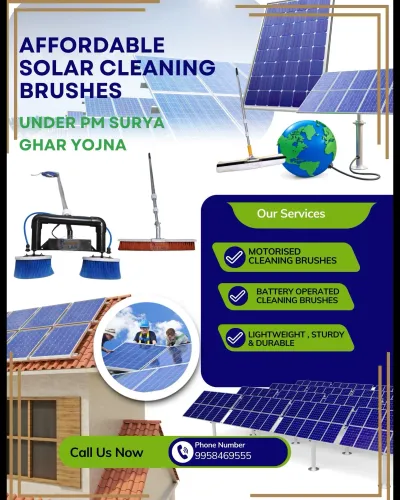
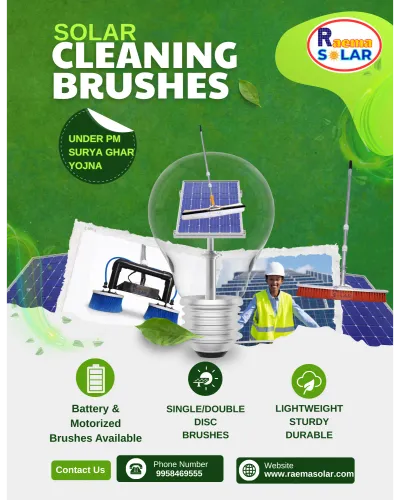
Manual, motorized, and battery-operated solar cleaning brushes allow cleaning without damaging the module surface. This makes them practical for both small rooftops and expansive industrial installations.
In dry and industrial environments, cleaning brushes are not optional tools. They are essential maintenance equipment.
How Often Should Solar Panels Be Cleaned in Coimbatore?
Cleaning frequency depends on rooftop exposure and surrounding activity:
- Independent homes: Every 25–30 days
- Apartments and housing societies: Every 15–20 days
- Textile mills and industrial sheds: Weekly or bi-weekly
Facilities near industrial estates or textile clusters often require more frequent cleaning to maintain consistent output.
Long-Term Efficiency and Asset Protection
Solar modules are designed to operate efficiently for 20–25 years. In Coimbatore’s dry and industrial conditions:
- Dust buildup causes uneven light absorption
- Prolonged contamination accelerates efficiency degradation
- Poor maintenance directly impacts long-term ROI
Regular cleaning using proper solar module cleaning brushes protects both daily generation and long-term system health. This is standard engineering maintenance practice, not an optional upgrade.
Practical Industry Experience in Coimbatore
Across Coimbatore, homeowners, textile units, and EPC partners increasingly rely on dedicated solar cleaning brushes. Leading manufacturers design these products specifically for Indian dry and industrial environments, taking into account dust type, heat exposure, and rooftop scale.
The move toward structured cleaning is driven by observed performance improvement and predictable financial returns.
Final Perspective
In Coimbatore, solar power loss does not happen suddenly. It happens daily, quietly, and cumulatively.
If solar modules are not cleaned correctly and regularly, daily power output and long-term ROI are already compromised—even when the system appears to be functioning normally ☀️.
Keywords